NTSB releases preliminary report into deadly Bangor plane crash
All six people on board the plane died in the January 25 crash
BANGOR, Maine (WABI) - The National Transportation Safety Board has released its preliminary report into January’s fatal plane crash at Bangor International Airport. All six people on board were killed in the crash, including four passengers, the plane’s pilot and copilot. The plane was owned by Houston, TX personal injury law firm Arnold & Itkin. It is the most deadly crash to happen at KBGR, and one of the deadliest crashes in Maine’s history.
The biggest takeaways
The report says there was no evidence of issues with any airplane component or flight control prior to the crash. It also highlights discrepancies between the FAA’s guidelines on how much time should elapse between deicing and takeoff and the decision making of the pilots. CCTV footage reportedly shows multiple explosions taking place during the crash sequence, and damage of the wreckage was indicative of prolonged fire following the impact.
Investigators utilized CCTV footage from the airport, as well as cockpit voice recordings in the investigation.
The sequence of events
According to the report, the plane, N10KJ, a Bombardier Challenger 600 landed at Bangor International Airport’s runway 33 enroute from Houston, TX’s Hobby Airport at 6:09 p.m. on Sunday, January 25. The plane was on its first leg of a two-leg flight to Paris-Vatry Airport in France. The plane stopped at BGR to deice and refuel amid snowy conditions.
The flight data recorder shows the airplane first taxied to Bangor International Airport’s fixed based operator ramp to refuel. The plane was running on electronic power as its left-and-right engines were shut down. N10KJ’s total fuel load was about 19,872 lbs. after refueling.
At 7:13 p.m. the plane taxied to the deice pad, arriving at 7:17 p.m. CCTV footage reportedly shows the plane facing northwest as engines were once again shut down for de-icing procedures. Deicing began at 7:19 p.m. and finished about eight minutes later at 7:27. Airport documentation shows about 41 gallons of Type I deice fluid were used to deice the airplane.
Airport weather conditions when the anti-ice fluid was dispensed included light snow, visibility of 3/4 statute miles.
The airplane sat at the de-icing pad for just under five minutes before departing back to the runway. While enroute back to runway 33, the flight crew, Jacob Hosmer, 47, and Jorden Reidel, 33, both of Texas, discussed holdover times. Holdover time is the estimated period for which deicing or anti-icing fluid will prevent the accumulation of ice, snow or frost on an aircraft. The pilot commented it was “standard” to have 14-18 minutes between deicing and takeoff and that if the wait was more than 30 minutes, they would return to the ramp to deice again. The copilot concurred. According to the FAA Holdover Time Guidelines for Winter 2025-2026, the snowfall conditions that night were considered “moderate” and the temperature was in the single digits. The guidelines show a “moderate” snowfall intensity and the outside temperature should result in a maximum holdover time of 9 minutes from the start of the anti-ice application.
At 7:40 p.m. the Bombardier Challenger stopped 200 ft. before the runway’s short line. Air traffic controllers asked to pilots to report when they were ready for takeoff. The pilot advised they were ready two minutes later. The tower controller informed the flight crew of the conditions and that they were cleared for takeoff on runway 33. At 7:43 the plane resumed taxiing and the pilot correctly read back the takeoff clearance to the controller. There were no further interactions between ATC and the pilots.
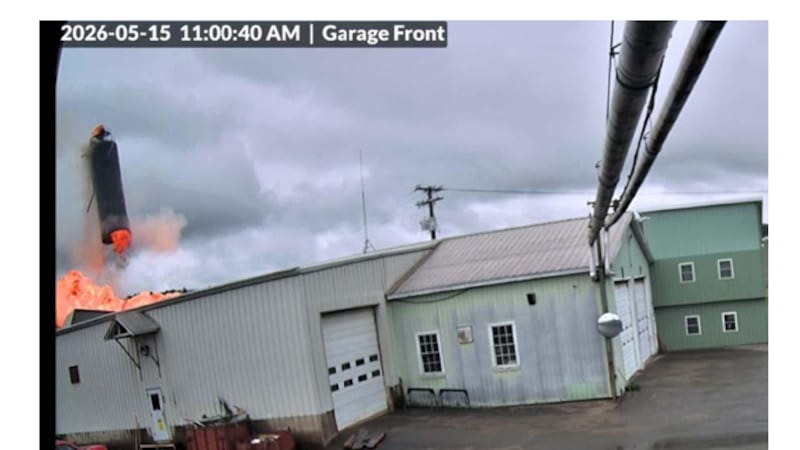
There were multiple airport CCTV cameras that captured the airplane during the takeoff. Several of these cameras showed the airplane impact the ground followed by multiple explosions as the impact sequence progressed.
Evidence of the impact sequence began with a series of scrapes on the runway and fuel residue. The scrape marks began about 5,808 ft from the approach end of runway 33, 42 ft. to the right of the runway centerline. A wide area of fuel residue was found that extended about 57 ft. near the right edge of the runway.
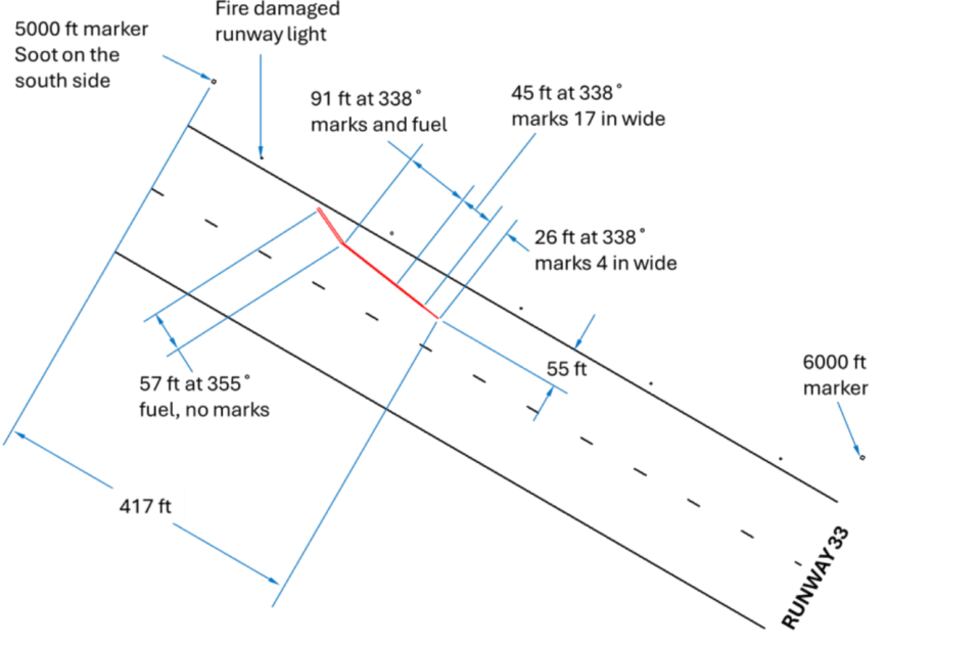
The plane veered to the right side of the runway into the grass before coming to a rest upside down. The cockpit and cabin exhibited thermal damage consistent with a prolonged fire following the impact.
The debris field was about 1,270 ft long and 150 ft wide. Photographs captured immediately after the accident showed the nose and main landing gear
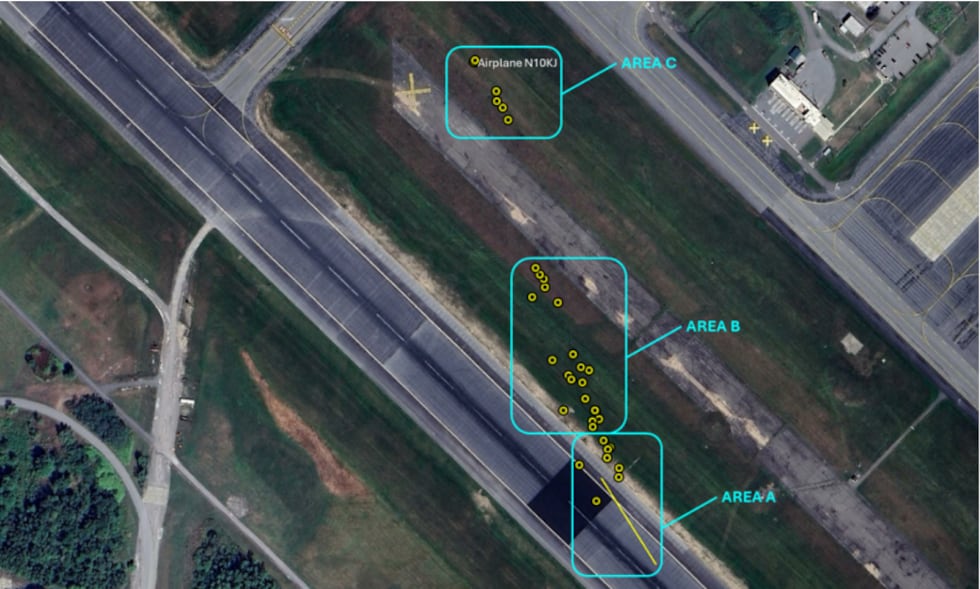
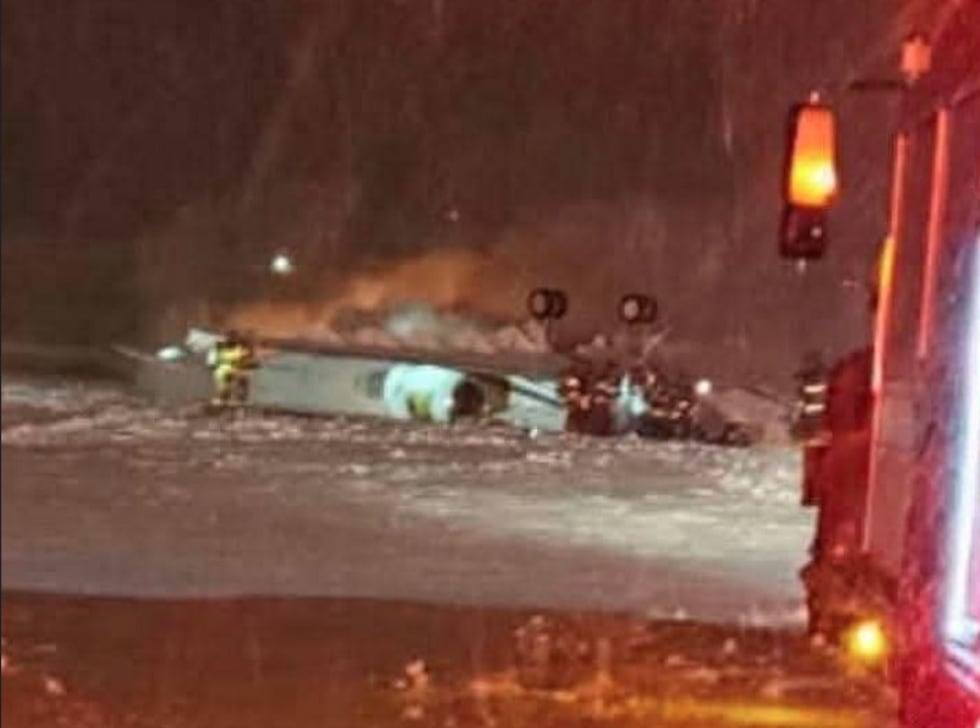
There was no evidence of a preimpact separation of any airplane component, flight control, or structure.
ATC audio shows just two-and-a-half minutes after being cleared for takeoff, a controller loudly radios: “All traffic is stopped on the field! All traffic is stopped on the field!”
Moments later, another controller is heard saying, “Aircraft upside down. We have a passenger aircraft upside down.”
Those on board
Tara Arnold, 46, and Shawna Collins, 52, both of Texas were among the passengers killed as well as Nick Mastrascusa, 43, and Shelby Kuyawa of Hawaii. Pilots Jacob Hosmer and Jorden Reidel were also killed.
Tara Arnold was an attorney at Arnold & Itkin and wife of the firm’s co-founder, Kurt Arnold. According to her biography on the website, Arnold was from Sabine Parish, Louisiana and an alumna of Tulane University Law School.
Arnold’s friend, Harris County Commissioner Lesley Briones spoke about her late friend in a press conference.
“My heart goes out to them and their children and their families. I worked at Arnold & Itkin for a time and so I know them well and this is just a tragedy,” Briones said. “In particular Tara is- she’s just a phenomenal person, a bold leader, and somebody who had a heart of service. So she was very involved in Precinct 4 and our sister non-profit Precinct 4 Forward. My heart and my prayers are with Kurt and their children and all of those affected members.”
Shawna Collins worked for Lakewood Church in Houston, run by Joel Osteen Ministries, where Collins worked, called her a “light that brightened their days.” Collins’ social media posts show her work organizing parties and events in Italy, Hawaii and elsewhere, for clients that included Arnold and Itkin.
“Everybody loved her. She just had that kind of personality,” church spokesperson Donald Iloff Jr. told The Associated Press.
Collins, who was married with children and grandchildren, had also been helping plan her daughter’s wedding set for this year, Iloff added. “She was very good at it. Everybody wanted her to plan her events for them.”
A fundraiser for Nick Mastrascusa’s family said he was a chef and father of three from Hawaii who touched many lives through his “kindness, dedication, generosity and friendship.”
Jacob Hosmer started working for Arnold and Itkin eight months ago as a “team captain,” according to his LinkedIn page. He had been a licensed flight instructor and the managing member of Platinum Skies Aviation LLC, incorporated in Texas in late 2024, online records show.
KHOU spoke to some of Hosmer’s friends, who say he was a pilot, but also had other passions. One of them was pickleball. Over the years, he gained multiple friends and playing buddies on the court.
The wreckage and the remains of those killed remained on the runway for several days following the crash, as local authorities waited for federal investigators to arrive. Their arrival in Maine was delayed by winter weather.
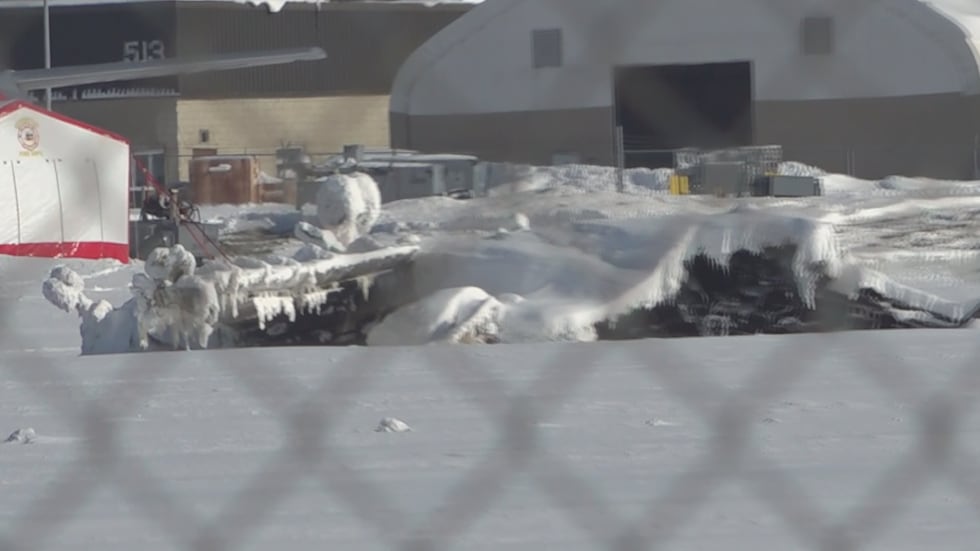
Upon clearing the debris, the remains were later taken to the Office of the Chief Medical Examiner in Augusta where they were identified.
Copyright 2026 WABI. All rights reserved.